

Input by J Kumalo
Higher Education Minister Blade Nzimande on Monday, placed the country firmly on the road towards free, dynamic and compulsory education for all. His announcement put over 70% to 80% of undergraduate students across the country in the coffers of the National Student Financial Aid Scheme (NSFAS) at an estimated cost of R2.5-billion. This move has realistically placed the country on the path free education.
He encouraged students to acknowledge the country’s inequalities and government’s limited resources and allow those with means to pay fee increases in 2017.
At some campuses, it appears Nzimande’s announcement has not been well received. The department’s decision came amid competing demands from students and universities. Nzimande could have continued the 2015 decision for government to pay for all fee increases, while risking the state fiscus and financial sustainability of universities. Or he could have encouraged institutions to keep their fee hikes low but allowed them to pass on the financial burden to students, which would have risked large-scale protests.
The minister found a balance. He said the reality of inflation means costs for higher education are rising and performance will suffer unless institutions are able to match the increased costs. Further more, to ensure the poor, working and middle-class families are not excluded from the fee increases, government will pay for fee increases up to 8% for students on NSFAS and the “missing middle”, those with a household income of up to R600,000 per annum.
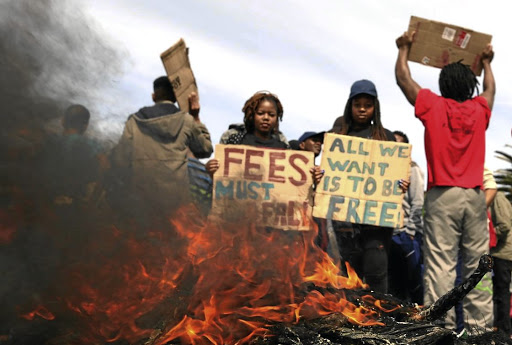
This move by minister Nzimande is a response of a caring government to calls on fees that has griped our country in at least the past year and a half. SA students have been locked into a bitter struggle against their universities over exorbitant, above-inflation and unreasonable fee increases. University councils and administrations hide behind institutional autonomy both to swindle parents and students through unregulated fee increases as well as to reject government intervention to regulate the fees across the board in order to make higher education both affordable and accessible.
What seemed to be protest action involving students from historically-white universities has caught the attention of the whole country, and even the international community, and earned the students the sympathy of the nation. The ANC Secretary General, Gwede Mantashe, has described the students demands as “reasonable and understandable”, and I would add, justified!
While others have opportunistically rushed to shift the blame for these protests to the doorsteps of the ANC and government, the majority of the students have been very clear that such must be placed right before their councils and administrations. To raise the fees in October just before exams, when the students attention is turned towards this all-important period, seems like a con-attempt to trick the students unwittingly to accept increments.
However, two quick reminders must be made in this regard. Exorbitant fee increments have been the order of the day in historically-black universities since time immemorial. Students at these universities are reeling under the heavy pressure of these fees and plunged into the whirlpool of debt that ties them for the unforeseeable future, which makes it impossible for them either to complete their studies or, if they do, to escape the debt trap and the vicious cycle of inequality which will, inevitably, tie their own off-springs.
Secondly, at these historically-black universities, fees are increased during this period and this has been the case since time immemorial. I remember when we embarked on a university shut-down at the University of Durban-Westville (now UKZN) in 1993 just days before exams precisely for similar reasons. What gave us a breakthrough was an agreement reached between the SRC and the university administration that there would be no increment on the registration fees, which enabled us to convince the students to suspend the protest action, sit for the exams and thus resume our protest action soon after registration the following year.
However, this year, students have unequivocally said – NOT THIS TIME! Not this time!
The fact is that we have not been paying attention to the astronomical rise in the university fees and we have been blackmailed by universities through institutional autonomy. We have doubled university admissions / access and more than trebled the NSFAS, but NSFAS has been bludgeoned by poor administration, weak funding formula, exclusion of the children of middle-class parents who nonetheless cannot afford university fees (such as teachers and other middle-level public servants on the grounds that they earn an income), corruption and a large part of the NSFAS funding pays salaries and other administration cost.
This has blurred even these massive achievements whilst the situation of the youth has been deteriorating. Many of these youth are compelled to quit their studies because of inability to afford university fees. SASCO had every year during the mid-nineties led national campaigns against financial exclusions.
At the same time, those who complete their studies are plunged into a socially-internecine debt trap they cannot escape for years after completion of their studies. Years of study are expected by society, families and students themselves to be an escape route from poverty and a licence to a better life. Unfortunately this is not so in our case. Whether you are financially-excluded or still complete your studies, debt awaits you.
When many black students complete their studies, they are expected to begin immediately to take care of their families, assist in the education of their younger siblings and still begin constructing their own future. Usually, it is their future that takes a back seat as they have urgent family legacy issues to take care of, otherwise their own conscience will never grant them peace. The vicious cycle of inequality is thus perpetuated and will surely affect future generations which are the off-springs of the debt-ridden generations.
What compounds this situation is the high levels of unemployment among black young people, meaning that even when you complete your studies, saddled with enormous study debts, you still have a few years of unemployment and a debt whose repayment awaits you nonetheless.
All these factors highlight the battering that black students in particular are facing and underscore the class and racial dynamics of the protest action sweeping our country. This is a legacy of apartheid-colonialism, and particularly of the system of white monopoly capitalism which has continued untrammelled during the past few years. It highlights the urgent challenges of our situation to answer the question, what exactly do we mean when we talk of racial socio-economic transformation! This urgent task of the second phase of the transformation cannot continue to be treated casually as a rhetorical academic exercise, itself an opium of the masses.
Education, and particularly higher and further education and training must feature prominently in that discourse. Students are demanding that the nation views and treats their education as an investment instead of a mere “expenditure”. To this, we must provide an unequivocal, bold and resolute response.
The Each One Teach One Foundation (EOTOF) finds itself at the centre for the struggle for better education by millions of young people who suffered and died for decades on end can have no impact on or contribute to national liberation or social transformation despite the best efforts by the democratic government because of the grip of capitalist racism on our education system.
This, we believe, explains the silence by captains of industry in South Africa as millions of young people cry for access to education. The exploitative majority white monopoly capitalists generate trillions of rand from our economy and can afford to assist the country in producing the skilled labour meant for their exploitative gain ultimately, but they wont. After all, this provides them with the power of being the dominant forces and major beneficiaries of the structural position the reproduction of capitalist and racist relations.
Under white monopoly capitalism, the education system is deprived of all autonomy to further other, progressive and revolutionary objectives. Even after the seizure of power and the destruction of the apartheid, capitalist system continues to dominate the educational system and the social system. Hence, we urge the democratic government not to flinch on its path towards radical transformation of education and our society.
We locate the call by the young people at our universities to access to these institutions as part of the call for People’s Education for People’s Power. This concept, vision and programme of action, as championed by the Congress of South African Students and adopted by the National Education Crisis Committee (NECC) out of the education crisis of 1985, it is based on a rejection of Apartheid education and capitalism.
People’s Education can be described as “a deliberate attempt to move away from reactive protests around education to develop a counter-hegemonic education strategy, to contribute to laying a basis for a united, free, democratic and prosperous South Africa.”
As part of the support for the noble course by students in the universities EOTOF must support People’s Education as both an educational and a political programme. The struggle for alternative education was part of the political struggle for a democratic non-racial South Africa.
With the events of the past few days that has seen the country of fire, we are the historic custodians of the call for free, dynamic and peoples education for all, we can once again called upon by history to settle the outstanding account. Our task is clear, we must once again mobilise all in society especially our labour forces, industrial and community based organisation to mobilise and organise in support for building a better and education and an alternative South Africa. Just like the popular struggles of the 80’s we must ensure peoples full participation in a democratic society, build democratic organisation to sustain people’s power and deepen and develop revolutionary organisations.
History demand of us to call for unity of different sectors of society – parents, teachers, students and communities to support the transformation of our institutions of higher of education to ensure that they controlled democratically by and in the interests of the majority of the people.
We owe much to many generations, in particular the generation of 1976, a committed, dedicated generation that fought with bare hands against a most ruthless and evil system, and we dare not fail their ideas, their blood and their freedoms. It is up to you to decide whether you wish to fulfil or betray the mission of building an equal, just and better south africa, a south africa free of woman and child abuse, free of crime and corruption, a south africa that fights against substance abuse and HiV-aids.
It is upon the shoulders of the today’s young people, working closely with all the organs of people’s power to build a free nation and a South Africa free of exploitation of people by other people; a country whose wealth is shared among its people. As our former general secretary Cde Joe slovo put it: “the winning of the objectives of the Nationl Democratic Revolution will, in turn, lay the bases for a steady advance in the direction of deepening our national unity on all fronts – economic, political and cultural - and towards a socialist transformation for our working class. Nation building means, among other things, unifying themselves nationally as the leading class whose developing culture, aspirations and economic interest become increasingly those of the overwhelming people”.
It is the task of both young and old revolutionaries to work in unity for the suc- cess of the national democratic revolution and ultimately for a socialist south africa. Chairman mao said in 1957, “We must help all our young people to understand, ours is still a very poor country, that we cannot change this situation radically in a short time, and that only through the united efforts of our younger generation and all our people, working with their own hands can China be made strong and prosperous within a period of several decades”.